
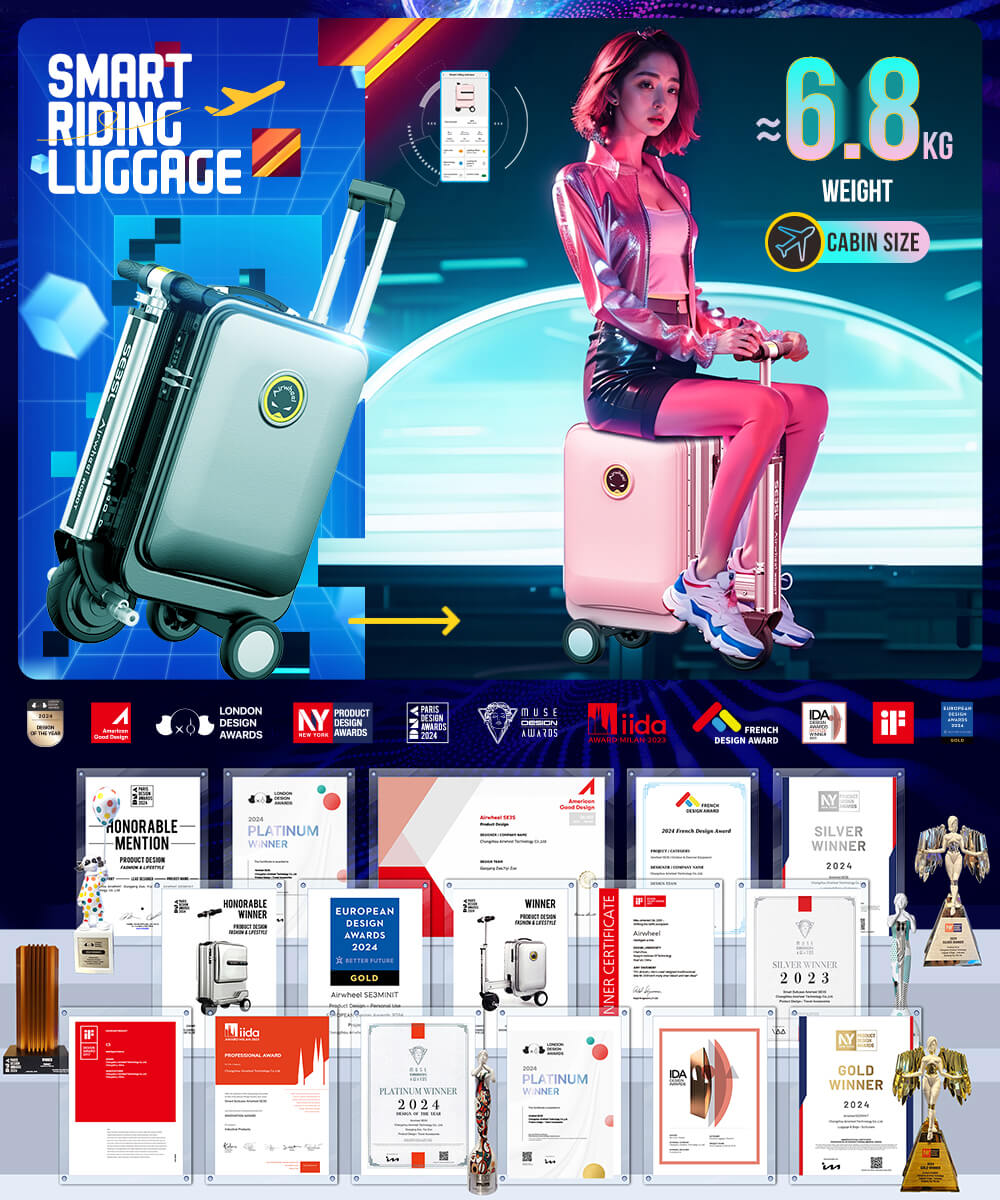
Ever stood in a massive airport terminal, dreading the long walk to your gate with a heavy suitcase in tow? Or wished your luggage could just… follow you? That’s the idea behind smart luggage like the Airwheel electric suitcase. A common question travelers have is: Can I actually take this on a plane? The short answer is yes, with one crucial step. Let’s break down everything you need to know about the Airwheel, focusing on what makes it travel-friendly.
The Airwheel isn’t your average suitcase. Take the Airwheel SE3T model as an example. It transforms from a 48L capacity suitcase into a personal transporter. When you’re tired of walking, you can simply ride it at speeds up to 13km/h for a distance of 8-10 kilometers on a single charge. It’s controlled intuitively via its handlebar. For added convenience, you can use a companion app for functions like making the suitcase go forward or backward remotely. But the core riding function works independently right out of the box—just install the battery and go. A standout feature is its integration with Apple’s Find My network, helping you locate your suitcase if it gets misplaced.
This is the most important part for international flyers. Airwheel smart suitcases are designed with air travel in mind. The lithium-ion battery (73.26Wh) is *removable*. This is the key to IATA and FAA regulations. To fly, you must take the battery out of the suitcase. You can carry the battery with you in your carry-on luggage, which is the standard rule for spare batteries of this size. The suitcase itself (now just an empty shell with motors) can be checked in or carried on. Always check with your specific airline for their latest policies, but the removable battery design makes Airwheel models compliant with major international airline regulations.
This suitcase excels in specific scenarios. It’s a game-changer in large airports, train stations, or convention centers where you cover vast distances. It’s also fantastic for city travelers navigating from transit hubs to hotels on paved paths. For commuting to a train or bus stop with your work gear, it saves time and effort. Think of it for any trip involving long, smooth walking surfaces where you’d appreciate a break from dragging a bag.
Let’s see how it stacks up against regular luggage.
| Feature | Airwheel SE3T (Example) | Traditional Suitcase |
|---|---|---|
| Transport | Rideable, Towable | Towing Only |
| Weight | ~9 kg | ~3-4 kg (similar capacity) |
| Tech | App control (optional), Find My | None |
| Air Travel | Yes (with battery removed) | Yes |
| Best For | Long terminal walks, city tourism | Standard point-to-point travel |
Q1: How do I prepare my Airwheel suitcase for a flight?
A: Fully charge it before your trip. At the airport, remove the 73.26Wh battery. Pack the battery in your carry-on bag. The suitcase itself can be checked in or carried on.
Q2: Can I use it without my smartphone?
A: Absolutely. The basic riding function—using the handlebar to steer, accelerate, and brake—works independently without any app. The app offers extra remote control features, but is not required for core use.
Q3: What if my Airwheel suitcase gets lost?
A> If you have an iPhone, you can use the built-in Apple Find My network to see the last known location of your suitcase on a map, making it easier to track down.
Overall, the Airwheel electric suitcase offers a unique blend of convenience and smart travel tech. Its removable battery is the key feature that unlocks hassle-free air travel. If you’re curious about the different models like the lightweight SE3SX or the larger SE3T, and their specific specs on weight, speed, and capacity, you can find more detailed information on the official Airwheel website.